
Credentials can get an expert considered. Here’s what helps them earn the interview.
When a major story breaks, journalists rarely have the luxury of spending hours searching for the perfect interview guest.
A producer might need an economist who can explain an unexpected jobs report, a physician who understands a developing public health issue, or a cybersecurity specialist who can explain a data breach without overwhelming the audience with technical language.
Finding someone with relevant credentials is the beginning. Deciding whether that person is right for the interview takes more work.
So what do journalists actually look for when booking an expert?
Here are seven factors that can influence the decision.
1. Relevant expertise, not just impressive credentials
A prestigious title might get someone’s attention, but it doesn’t automatically make that person the right source.
A university professor who studies economic policy may be an excellent guest for a discussion about inflation. That doesn’t necessarily make them the best person to explain a sudden disruption in local housing markets.
Journalists need expertise that matches the specific question their story is trying to answer.
That might come from academic research, professional experience, technical knowledge, or direct involvement in the subject.
What experts can do: Clearly identify the topics they can speak about with authority. A focused description of your expertise is often more useful than a long list of credentials.
2. The ability to explain complicated information clearly
Being knowledgeable and being understandable are two different skills.
A journalist may have only a few minutes to conduct an interview. A television producer may need a guest who can explain a complicated issue in a 30-second answer.
That doesn’t mean sacrificing accuracy. It means understanding how to communicate important information without burying the audience in jargon.
Consider the difference between explaining what happened and explaining why it matters.
The strongest interview guests can do both.
What experts can do: Practice explaining your area of expertise to someone outside your profession. Prepare clear examples and avoid assuming your audience understands industry terminology.
3. Credibility that can be independently verified
Journalists have a responsibility to evaluate the people they put in front of their audiences.
That means looking beyond a polished biography or an impressive social media following.
Depending on the story, a journalist may need to confirm professional affiliations, licenses, research, employment history, published work, or relevant experience.
They may also examine potential conflicts of interest.
An expert who has financial ties to a company being discussed, for example, may still provide useful information. But those relationships need to be understood and disclosed appropriately.
What experts can do: Maintain an accurate professional biography with verifiable credentials, relevant publications, institutional affiliations, and clear disclosures.
4. Responsiveness when deadlines are tight
News doesn’t wait for convenient schedules.
A producer working on a morning broadcast may be booking interviews while most of the country is asleep. A journalist covering breaking news may need an answer within minutes.
An expert who responds promptly and communicates availability clearly makes the booking process easier.
And when an expert cannot participate, a quick response saying so is often more helpful than silence.
Reliability also extends beyond the initial booking. Confirming logistics, arriving on time, and communicating unexpected problems can influence whether someone is invited back.
What experts can do: Keep contact information current, monitor professional inquiries, and be realistic about your availability.
5. An understanding of the interview format
A live television panel is different from a podcast. A documentary interview is different from a newspaper interview.
Each format places different demands on the guest.
A live television interview may require concise answers and the ability to respond to follow-up questions without much preparation time.
A long-form podcast may allow for detailed explanations and extended discussion.
A documentary interview may involve multiple takes, background conversations, and additional requests for supporting material.
Journalists and producers notice when guests understand the environment they’re entering.
What experts can do: Research the outlet, host, audience, and format before agreeing to an interview. Ask what the journalist hopes to cover and how your contribution will be used.
6. The ability to contribute something useful to the story
An expert shouldn’t simply repeat information a journalist can find through a basic online search.
The most valuable sources provide context, explain consequences, identify important distinctions, or challenge assumptions.
Sometimes that means explaining why a popular interpretation of an event is incomplete.
Other times, it means helping a journalist understand what remains unknown.
An expert who can acknowledge the limits of their knowledge may be more useful than someone who feels compelled to answer every question.
What experts can do: Think about the perspective your experience allows you to contribute. Be prepared to explain what the audience needs to understand, including uncertainty.
7. Professionalism that earns the next invitation
Getting booked once is an accomplishment. Becoming someone a journalist wants to work with again requires consistency.
Producers remember guests who arrive prepared, respect deadlines, communicate clearly, and contribute meaningfully to the finished story.
They also remember difficult experiences.
An expert who repeatedly cancels at the last minute, misrepresents their qualifications, or treats an interview primarily as an opportunity to promote a product may make future bookings less likely.
Professional relationships in journalism are built through repeated interactions.
What experts can do: Approach every interview as a professional collaboration. Be accurate, prepared, responsive, and respectful of the journalist’s responsibilities.
What matters most when journalists evaluate an expert?
The relative importance of these seven factors depends on the story, the outlet, and the deadline
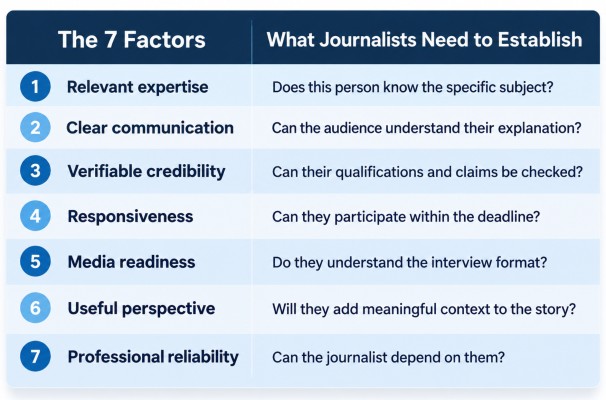
An expert may excel in six areas and still be the wrong choice for a particular assignment.
For example, someone with exceptional credentials who cannot meet a breaking-news deadline may be less useful for that interview than another qualified source who is available immediately.
The goal is to find the right combination of expertise, credibility, communication, and practical readiness for the story being produced.
How can experts improve their chances of being booked?
Start by making it easier for journalists to evaluate you.
A strong professional media profile should explain your areas of expertise, identify your qualifications, provide relevant examples of your work, and make it easy to contact you.
If you have previous media appearances, include them when relevant. If you have research, publications, or professional affiliations that support your expertise, make those accessible.
Just as importantly, be clear about the subjects you are qualified to discuss and the questions that fall outside your specialty.
A journalist shouldn’t have to guess what you know or whether you are available.
Making credible expertise easier to discover
At Coordius, we believe the process of finding and evaluating interview sources can be better.
Journalists, producers, podcasters, and other creators need reliable information about the people they are considering for interviews. Experts need a professional way to present their credentials, experience, and areas of knowledge.
Coordius is building a platform designed to help both sides discover, evaluate, and connect with one another.
Because the right interview begins long before the first question is asked.
Learn more at Coordius.com.